
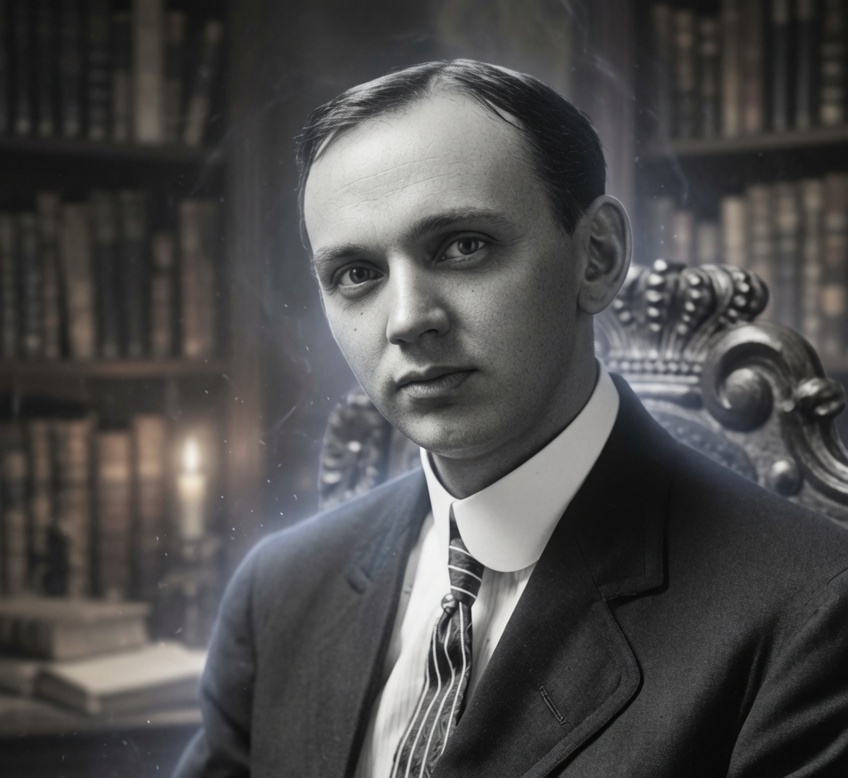
Part 1: The Reluctant Psychic
Thousands of Cayce's "readings" were written down and preserved, making him one of the most thoroughly recorded psychics in history. Who was the man behind the legend, and how did a small-town photographer come to be called America's Sleeping Prophet?
A Country Boy with a Gift
Edgar Cayce was born in 1877 on a farm near Hopkinsville, Kentucky. By every account he was a quiet, deeply religious boy who read the Bible cover to cover again and again. There was little in his upbringing to suggest he would one day be famous; he came from a modest farming family, had limited formal schooling, and spoke with the soft accent of the rural South his whole life.
Yet from childhood, those around him noticed something unusual. According to the stories later told about him, young Edgar seemed able to absorb information in strange ways. The most famous tale holds that, struggling with his school lessons, he fell asleep on his spelling book—and woke able to recite its contents perfectly, as though the knowledge had passed into him during sleep. Whether literally true or polished in the retelling, the story captured the essence of the gift he would become known for: knowledge that came not from study, but from somewhere beyond ordinary waking thought.
The Voice That Vanished
The turning point in Cayce's life came not through ambition but through affliction. As a young man, he suffered a mysterious loss of his voice, falling into a near-total laryngitis that doctors could not cure and that threatened to end his livelihood. For months he could barely speak above a whisper.
In desperation, he turned to an unconventional remedy. A hypnotist placed Cayce into a trance, and while in that sleep-like state, Cayce himself reportedly spoke in a clear, normal voice—and diagnosed his own condition, describing the physical cause of his ailment and prescribing what his body needed to heal. When the suggested remedy was followed, his voice returned.
It was an astonishing event, and it pointed to something remarkable: in his trance state, the soft-spoken Cayce seemed able to perceive things about the human body that he had no medical training to know. Word spread, and soon others came asking whether the sleeping man might diagnose their ailments too.
The Birth of the Readings
Thus began the practice that would define his life. Cayce would lie down, loosen his tie and shoelaces, fold his hands over his stomach, and put himself into a trance resembling sleep. A question would be posed to him—often the name and location of a sick person, even one far away whom he had never met—and the sleeping Cayce would begin to speak, describing the person's condition and recommending treatments.
These sessions came to be called "readings," and they were carefully recorded. A stenographer wrote down his words as he spoke, and over the decades these transcripts accumulated into an enormous archive—more than fourteen thousand readings, preserved and catalogued. It is this meticulous documentation that sets Cayce apart from so many other psychics: his pronouncements were not vague memories recalled years later, but written records taken down as they happened.
What troubled Cayce himself, by many accounts, was that he could never remember a word of what he said. He was a sincere Christian who taught Sunday school and worried deeply about whether his strange gift came from God or from somewhere darker. He never fully understood it, never sought wealth from it, and remained, to the end, a reluctant prophet uneasy with his own fame.
Part 2: The Healing Readings
The vast majority of Cayce's readings—the heart of his life's work—concerned health and healing. People wrote to him from across the country describing illnesses that had baffled their doctors, and Cayce, lying in his trance, would respond with diagnoses and detailed prescriptions.
Medicine from a Trance
What made these readings so striking was their specificity. The sleeping Cayce would describe a patient's internal condition in clinical detail and prescribe elaborate treatments: particular diets, osteopathic adjustments, herbal tonics, poultices, and remedies that were sometimes obscure or old-fashioned. At times he reportedly named medicines and substances that the simple, largely self-educated Cayce had no business knowing. On occasion, the readings are said to have referenced compounds so rare that they could barely be located.
To his followers, the results spoke for themselves. Many people who received readings reported real improvement, and grateful letters poured in. They saw in Cayce a genuine healer, a man whose unconscious mind could reach across distance to perceive a stranger's suffering and find the path to relief.
A Holistic Vision Before Its Time
One of the reasons Cayce's health readings still attract interest is that they emphasized ideas that were unusual for the early 20th century but feel familiar today. He stressed the importance of diet, posture, attitude, and the unity of body, mind, and spirit. He spoke of the body's ability to heal itself when properly balanced, and of illness as something to be understood holistically rather than treated as an isolated symptom.
Many of the principles he advocated—attention to nutrition, the mind's influence on physical health, gentle and preventive care—anticipated themes that would become central to later holistic and alternative medicine movements. Admirers point to this as evidence that Cayce was ahead of his time, perceiving truths about wellness that mainstream medicine would only embrace decades later.
The Skeptics Respond
Critics, of course, see it differently. They note that Cayce lived in an era of widespread folk medicine and patent remedies, and that much of what he prescribed drew on the alternative healing ideas already circulating in his day. The improvements people reported, skeptics argue, can often be explained by the natural course of illness, the placebo effect, or the simple comfort of believing one is being helped.
They also point out that the readings were not subjected to rigorous testing, and that the successes were remembered and celebrated while failures faded from view. A diagnosis vague enough, or a remedy harmless enough, could seem to "work" without any genuine clairvoyance involved.
Yet even skeptics often acknowledge that Cayce appeared sincere. He does not fit the mold of the cynical fraud chasing fortune. He charged little, gave many readings for free, agonized over the morality of his gift, and seemed genuinely to believe he was helping people through a power he could not explain. Whatever the true source of the readings, the man delivering them appears to have believed in them himself.
Part 3: Prophet of the Future and the Past
As the years passed, the questions put to the sleeping Cayce expanded far beyond illness. Followers began asking him about the soul, the afterlife, the meaning of dreams, the rise and fall of civilizations, and the shape of things to come. And in his trance, Cayce answered—venturing into territory that transformed him from a healer into a full-fledged prophet and mystic.
Beyond the Body
These broader readings introduced ideas that startled his devoutly Christian audience. Cayce spoke of reincarnation, describing the past lives of those who came to him and weaving a vast spiritual philosophy of the soul's journey across many lifetimes. For a Sunday school teacher who took the Bible literally, this was a source of genuine inner conflict—yet the readings continued to deliver it, whether he willed it or not.
Atlantis and the Ancient World
Among the most famous of his trance pronouncements were those concerning the lost civilization of Atlantis. Cayce described it in vivid detail—an advanced society possessing remarkable technologies and powers, which he said had destroyed itself through misuse of its own knowledge. He spoke of souls who had lived in Atlantis being reborn in the modern age, and even offered a prediction that part of the sunken land would rise again near the island of Bimini in the Bahamas.
He also gave readings about ancient Egypt, offering an unconventional account of the building of the Great Pyramid and the Sphinx, and claiming there existed a hidden "Hall of Records"—a secret chamber containing the history of Atlantis—buried somewhere near the Sphinx. These ideas have fascinated seekers and fringe researchers ever since, inspiring expeditions and endless speculation, even as mainstream archaeology has found no evidence to support them.
Visions of Things to Come
Cayce also made predictions about the future, and these are among the most debated parts of his legacy. Some are credited by believers as remarkable hits: readings that seemed to anticipate economic turmoil and the great stock market crash, and references to global conflict in the years that followed.
Others were dramatic and did not come to pass as described. He is associated with predictions of sweeping geological upheavals—great earth changes, shifting coastlines, and catastrophes that believers expected within the 20th century but which did not occur on the timeline imagined. As with many prophets, his admirers tend to emphasize the apparent successes, while critics point to the misses and to the elastic way vague predictions can be interpreted after the fact.
What is undeniable is the sheer scope of his vision. From a humble cot in the American South, the sleeping Cayce ranged across time and space—into the body, the soul, the ancient past, and the unknown future—producing a body of material that people are still studying a century later.
The Legacy of the Sleeping Prophet
Edgar Cayce died in 1945, worn out, some said, by the toll of giving so many readings. But his legacy did not die with him. The organization he founded to preserve and study his readings has kept his work alive, and his archive of transcripts remains one of the largest and best-documented records of any psychic in history.
His influence reaches further than his name alone might suggest. Many ideas that flowed through his readings—holistic health, the mind-body connection, reincarnation, spiritual seeking outside traditional religion—became cornerstones of the later New Age movement, for which Cayce is often regarded as a founding inspiration.
Whether one sees him as a genuine seer, an unconscious channeler of folk wisdom, or a sincere man whose mind played extraordinary tricks, Edgar Cayce remains a singular figure. He sought no glory, never claimed to understand his own gift, and spent his life troubled by the very powers that made him famous. In that humility lies part of his enduring appeal—the quiet, kindly photographer from Kentucky who lay down, closed his eyes, and seemed to speak with a voice that knew far more than he ever did awake.
Healer or dreamer, prophet or puzzle, Edgar Cayce sits forever at the boundary between the known and the unknown—a man whose mysteries we are still trying to solve.