
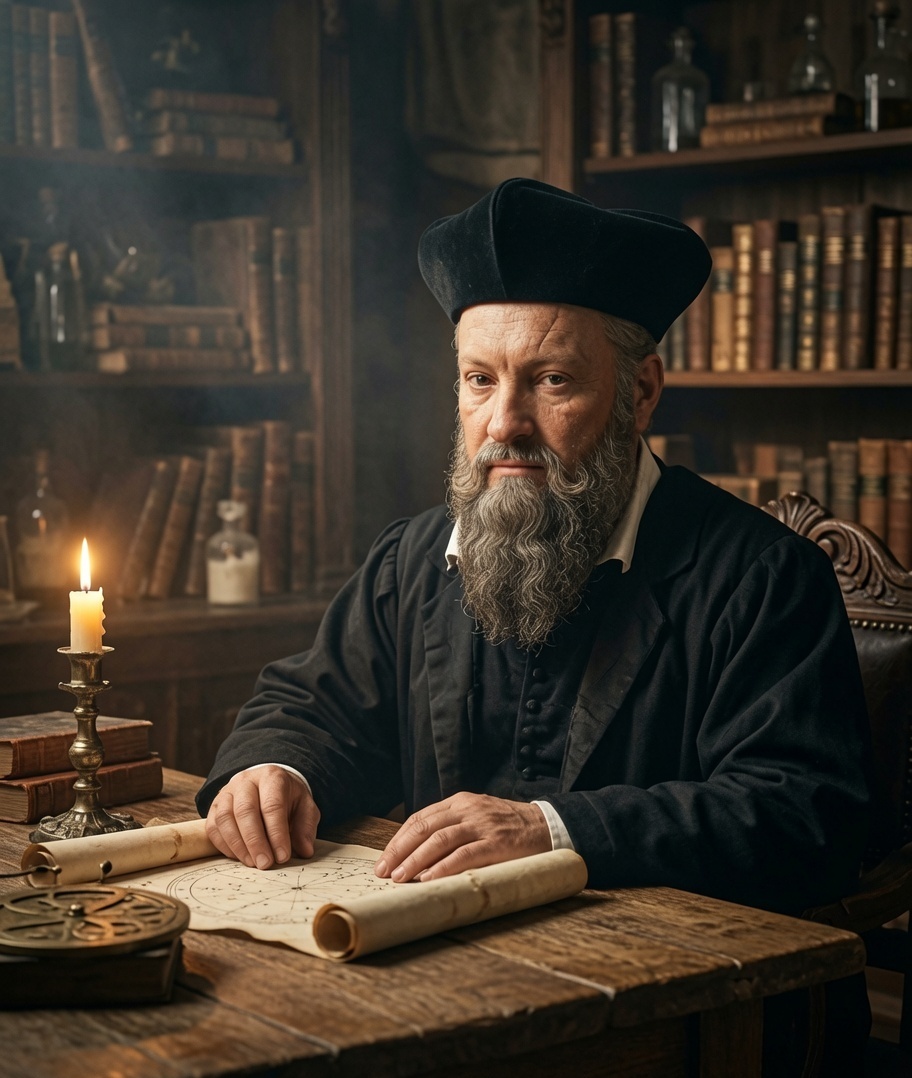
Part 1: The Making of a Seer
Wars, revolutions, the rise and fall of tyrants, disasters in our own lifetimes—all have been read into Nostradamus's strange, riddling lines. Who was this man, and how did a 16th-century Frenchman become the most enduring prophet in history?
A Child of a Troubled Age
Michel de Nostredame—later known by the Latinized name Nostradamus—was born in 1503 in Saint-Rémy-de-Provence, in the south of France. It was an age of upheaval and fear. Plague swept through Europe in deadly waves, religious conflict simmered, and superstition shaped daily life. People lived close to death, and many looked to the heavens, to omens, and to holy men for some sense of what lay ahead.
Born into a family of recent converts from Judaism to Catholicism, young Michel grew up in a household that valued learning. According to tradition, it was his grandfather who first introduced him to the mysteries of the heavens, teaching him the rudiments of astrology and the movements of the stars. Whether or not the details are exact, the boy showed an early hunger for knowledge that would carry him far beyond his provincial origins.
The Healer Who Faced the Plague
As a young man, Nostradamus trained as a physician. This was no small calling in an era when the plague could empty entire towns within weeks. While many doctors fled at the first sign of the disease, Nostradamus is remembered for doing the opposite—traveling toward the outbreaks, treating the sick, and earning a reputation for courage and skill.
His methods were said to be unusually effective for the time. He reportedly emphasized fresh air, clean water, and a gentler approach than the brutal treatments common in that era. Some of his remedies, particularly his rose-petal pills, became locally famous. To the people he helped, the young doctor must have seemed to possess an almost uncanny insight into matters of life and death—a reputation that would later blur the line between physician and seer.
Tragedy and Transformation
But for all his skill against the plague, Nostradamus could not save those closest to him. According to the accounts of his life, his first wife and their children died—possibly of the very disease he had spent his life fighting. The loss was devastating. The healer who had saved so many strangers had been powerless to protect his own family.
Some who have studied his life believe this profound grief marked a turning point. Shattered and searching for meaning, Nostradamus is said to have withdrawn into years of wandering and study, turning away from medicine alone and toward the older, stranger arts of astrology, mysticism, and prophecy. If he could not hold back death, perhaps he could at least learn to see what was coming.
Gazing Into the Future
It is in this later period that the most famous legends of his methods take shape. By his own cryptic descriptions and the accounts that grew around him, Nostradamus practiced a form of nighttime divination that sounds like something out of a fairy tale.
The legend holds that he would sit alone late at night in his study, before a brass bowl filled with water set upon a tripod. Gazing into the still surface by candlelight, he would fall into a trance, and visions of the future would rise before him. Some accounts add the use of a flickering flame, the murmuring of incantations, and a state of mind suspended between waking and dreaming. From these trances, it is said, came the strange and haunting images he would later set down in verse.
How much of this is true and how much is later embellishment is impossible to know. Nostradamus himself wrote of receiving prophetic illumination, framing it in religious and astrological terms. What is certain is that, by middle age, the plague doctor of Provence had transformed into something else entirely: a seer who claimed to read the secrets of time itself. And he was about to commit those secrets to paper in a form that would puzzle the world for centuries.
Part 2: The Prophecies
In 1555, Nostradamus published the work that would secure his fame for all time: Les Prophéties. It was a vast collection of predictions, written not in plain prose but in four-line verses called quatrains, grouped into sets of one hundred known as "Centuries"—a reference to the number of verses, not to spans of years.
The Book That Made Him Immortal
The quatrains did not unfold in any clear order. They leapt across time and place, offering glimpses of fires, floods, battles, fallen kings, and strange portents, with little to anchor them to any specific date. From the moment of its publication, the book was both wildly popular and deeply baffling—exactly as its author may have intended.
A Language of Riddles
What set Nostradamus apart from every fortune-teller of his age was his style. He wrote in a deliberately obscure manner, blending French with Latin, Greek, and Provençal, scrambling word order, inventing anagrams, and burying names within wordplay and symbol. A single quatrain could be read a dozen ways, its meaning shifting depending on the reader.
Why write this way? Several theories have been offered. Some believe he obscured his meaning to protect himself—prophecy and astrology could draw dangerous accusations of heresy or witchcraft, and a prophet who foretold the deaths of kings needed deniability. Others argue the vagueness was the very point: verses that could mean almost anything would seem to "come true" again and again, in every generation. And to believers, the obscurity is evidence of genuine vision—a man straining to describe events centuries away, with no words for the wonders and horrors he saw, forced to render them in symbol and riddle.
Whatever the reason, the effect was the same. The quatrains became a mirror in which every age could see its own hopes and fears reflected back.
Favor at the Royal Court
Nostradamus did not labor in obscurity. His growing fame as an astrologer and seer reached the highest circles of France, and he won the powerful patronage of Catherine de' Medici, the queen consort and one of the most influential figures in the kingdom. She is said to have summoned him to court, consulted him on the fortunes of her children, and held his counsel in high regard.
For a man who dealt in dangerous arts, royal protection was invaluable. It lent his prophecies an air of legitimacy and shielded him from the suspicion that might otherwise have destroyed him. Under Catherine's favor, Nostradamus rose from a provincial astrologer to a celebrated figure at the heart of French power.
The Prophecy of the Fallen King
The single event that cemented his reputation in his own lifetime was a prophecy said to foretell the death of King Henry II of France. One of his quatrains spoke of a young lion overcoming an old one in single combat, of eyes pierced through a golden cage, and of a cruel death.
In 1559, King Henry II took part in a jousting tournament. His opponent's lance shattered, and a splinter pierced the king's gilded visor, driving into his eye and brain. He died in agony days later. To a public primed to find meaning in the quatrains, the match seemed undeniable: the old lion and the young, the golden cage of the visor, the pierced eyes, the cruel death. Word spread that Nostradamus had foreseen the king's end years before it happened.
Skeptics have long pointed out that the connection was drawn only after the fact, and that the verse names no king and no tournament. But in 1559, none of that mattered. The prophecy of the fallen king made Nostradamus a legend, and his book of riddles a sensation that would outlive him by centuries.
Part 3: The Legend Across the Centuries
Nostradamus died in 1566, but his prophecies were only beginning their long life. As the centuries unfolded, believers found his fingerprints on event after event, matching his cryptic verses to the great catastrophes and turning points of history.
Echoes Through History
The Great Fire of London in 1666 was tied to a quatrain mentioning fire in a great city. The bloody upheaval of the French Revolution was read into verses about common people overthrowing their masters. The rise of Napoleon was seen as the coming of a great emperor from humble origins. And to this day, his most fervent interpreters point to lines they say describe the world wars of the 20th century—even claiming he named a tyrant called "Hister," which believers read as Hitler.
In each case, the pattern is the same: a momentous event occurs, and interpreters return to the quatrains to find the verse that seems to match. The obscure, symbol-laden lines almost always yield something that can be made to fit.
A Prophet for the Modern Age
Far from fading with time, Nostradamus's fame has only grown in the modern era. His name resurfaces after nearly every major disaster. Believers have connected his verses to the assassination of John F. Kennedy, the September 11th attacks, pandemics, and natural catastrophes. Each new tragedy sends people back to the centuries-old quatrains, searching for confirmation that it had all been foreseen.
This enduring relevance is part of what makes him unique among prophets. Where countless other seers made specific predictions that simply failed and were forgotten, Nostradamus offered something different: verses vague and flexible enough to seem endlessly applicable. He has become less a historical figure than a permanent feature of how the modern world processes calamity—the ghost we summon whenever events feel too strange to be coincidence.
The Skeptics' Case
Not everyone is convinced, and the case against Nostradamus's powers is a strong one. Critics make several key points.
First, the prophecies are almost always "discovered" after the event, not before. No one, skeptics note, has ever used the quatrains to reliably predict a major event in advance—the matches are made only in hindsight. Second, the verses are so vague and symbolic that they can be bent to fit almost anything; with enough creativity, a single quatrain can be linked to events centuries and continents apart. Third, many of the most dramatic "matches" rely on loose translation, mistranslation, or outright alteration of the original text. The famous "Hister," for example, was an old name for the lower Danube River, not a misspelling of Hitler. And over the centuries, forged quatrains and invented prophecies have been falsely attributed to him, muddying the record still further.
To the skeptic, Nostradamus is not evidence of prophecy but a fascinating case study in how the human mind finds patterns, reads meaning into ambiguity, and remembers the hits while forgetting the misses.
Why He Endures
And yet, none of this has dimmed his fame. Five centuries after he gazed into his bowl of water by candlelight, Nostradamus remains the most famous prophet who ever lived—his name a byword for prediction itself.
Perhaps that endurance is the truest mystery. Whether one sees him as a genuine seer, a clever poet, or a mirror onto which each generation projects its own anxieties, Nostradamus has achieved a kind of immortality that no skeptic's argument can undo. His verses still wait, ambiguous and haunting, ready to be read anew by the next age that wonders what the future holds. In that sense, the plague doctor of Provence may have found a stranger immortality than even he imagined—not in seeing the future, but in becoming a permanent part of it.
Saint or charlatan, seer or symbol, Nostradamus sits forever at the boundary between the known and the unknown—a man whose mysteries we are still trying to solve.