
Part 1: The Rise of a Celebrity Psychic
Above all, Jeane Dixon was known for a single chilling prediction that seemed to foretell the assassination of a president. Who was the woman behind the headlines, and why does her name still echo whenever we talk about prophecy and its limits?
From California to the Capital
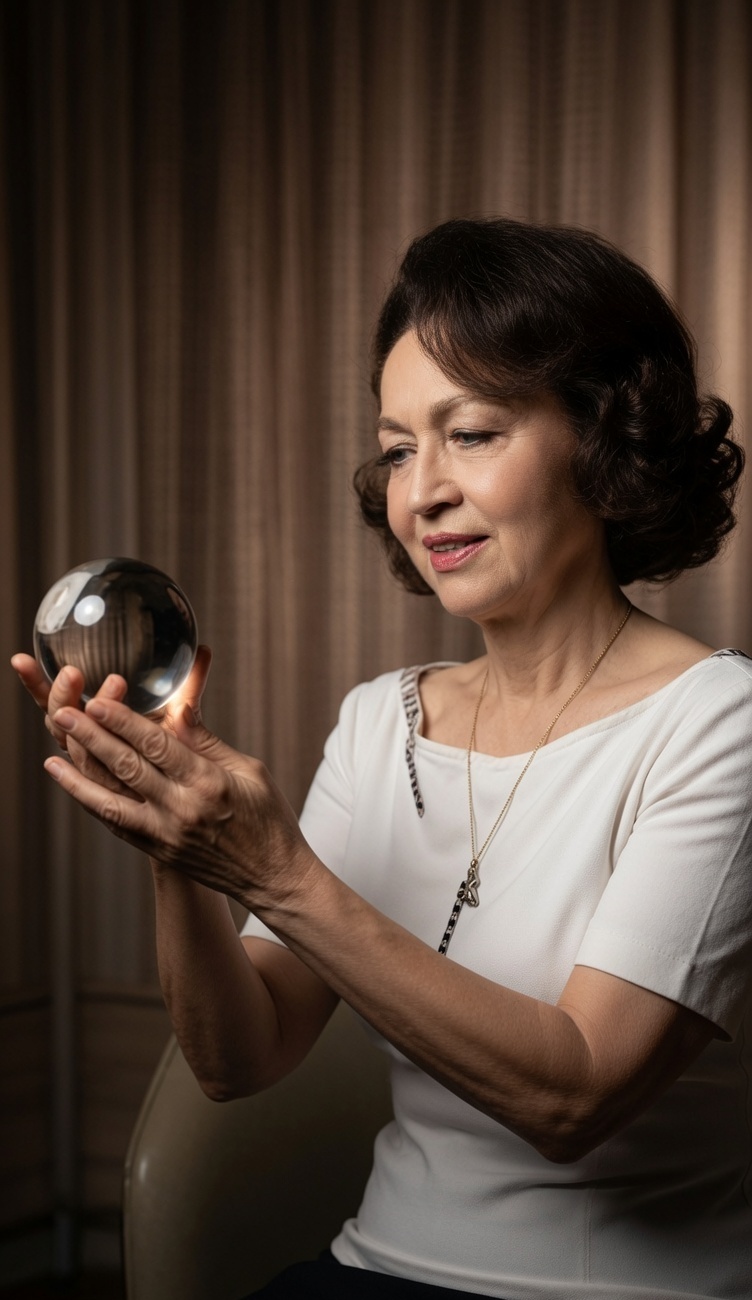
Jeane Dixon was born around the turn of the 20th century—the exact year is a matter of some dispute—and grew up in California. According to the story she told of her own life, her gift revealed itself early. As a child, she was said to have been taken to a gypsy fortune-teller who recognized something unusual in the girl, presenting her with a crystal ball and predicting she would grow up to be a great seeress. Whether history or polished origin story, it set the stage for the legend she would build.
She married James Dixon, a successful businessman, and the couple eventually settled in Washington, D.C. It was there, amid the city's powerful and well-connected, that Jeane Dixon transformed from a woman with an interesting hobby into one of the most famous psychics in the world. Washington gave her an audience of politicians, diplomats, and socialites—exactly the kind of high-profile circle in which a reputation for prophecy could spread quickly and carry real weight.
The Tools of the Seeress
Dixon drew on a blend of methods that gave her a distinctive mystique. She was a devout Roman Catholic who framed her abilities in religious terms, describing her visions as a gift from God and seeing no conflict between her faith and her prophecy. At the same time, she practiced astrology, read crystal balls, and used a deck of cards, weaving together the spiritual and the occult in a way that fascinated her followers.
Her style was warm, confident, and reassuring. She presented herself not as a mysterious figure lurking in shadows but as a respectable, well-dressed lady of society who happened to possess an extraordinary gift. This blend of glamour, religion, and the supernatural made her enormously appealing to a mainstream American audience, and it set her apart from the dramatic mystics of earlier eras.
Fame Beyond the Salon
As her reputation grew, Dixon became a genuine media celebrity. She wrote a syndicated astrology column that ran in newspapers across the country, reaching millions of readers daily. Her predictions for the year ahead became an annual fixture, eagerly reported each new year. Books were written about her, and one in particular would catapult her to national fame.
By the height of her career, Jeane Dixon was a household name—the psychic Americans thought of first, the seeress whose pronouncements made news. But all of that fame rested largely on the foundation of one extraordinary prediction, made years earlier, that seemed to come true in the most tragic way imaginable.
Part 2: The Prophecy That Made Her Famous
The cornerstone of Jeane Dixon's legend was her apparent prediction of the assassination of President John F. Kennedy. The story traces back to a magazine article published in 1956—years before the event.
A Vision of a Fallen President
In that 1956 article, Dixon was reported to have foreseen that the 1960 presidential election would be won by a Democrat, who would then die or be assassinated in office.
When President Kennedy, a Democrat elected in 1960, was assassinated in Dallas in November 1963, the prediction seemed to have come true with stunning accuracy. To a shocked and grieving nation searching for meaning, here was a woman who had apparently seen the tragedy coming years in advance. The prophecy electrified the public and turned Jeane Dixon into a national sensation almost overnight.
The Gift of Prophecy
The Kennedy prediction became the centerpiece of a hugely successful 1965 biography of Dixon called The Gift of Prophecy. The book sold millions of copies, spread her fame around the world, and fixed her reputation as the woman who had foreseen the death of a president. It recounted this and other apparent successes, cementing the image of Dixon as a seeress of remarkable power.
Riding this wave of fame, Dixon's influence reached extraordinary heights. It was widely reported that prominent figures consulted her, and her annual predictions were awaited each year as news in their own right. For a time, she was perhaps the most trusted psychic voice in America—a status built almost entirely on the foundation of that single, haunting forecast.
The Closer Look
But the famous prediction does not hold up as cleanly as the legend suggests, and skeptics have examined it closely. The original 1956 wording was more hedged than memory holds: Dixon reportedly framed it as a possibility, suggesting the president elected in 1960 would be "assassinated or die in office," not a flat certainty. More tellingly, in the years between that article and 1963, Dixon herself made statements that contradicted it—at one point reportedly predicting that Kennedy would not win the presidency at all.
This points to a deeper pattern that critics identified in her work. Like many prominent psychics, Dixon made an enormous volume of predictions every year. The vast majority were vague, safe, or simply wrong, and they were quietly forgotten. But the rare prediction that happened to match a real event was remembered, celebrated, and repeated endlessly. The successes became legend; the failures vanished from memory.
Part 3: The Legacy of a Prophet
So striking was this pattern in Dixon's career that it gave rise to a named concept. A mathematician studying her record coined the term the "Jeane Dixon effect" to describe the tendency to loudly trumpet a few correct predictions while conveniently ignoring the much larger number that turned out to be false.
The Jeane Dixon Effect
The phrase entered the vocabulary of skeptics and remains a useful way of describing how psychics, astrologers, and pundits can build a reputation for accuracy that the full record does not support.
In this sense, Dixon's legacy is double-edged. To her believers, she was a genuine prophet touched by God. To her critics, she became almost a textbook example of how the illusion of prophecy is created—not through deception necessarily, but through the natural human habit of remembering the hits and forgetting the misses. That her name became attached to the very phenomenon that explained her fame is one of the great ironies of her story.
The Predictions That Missed
A fair look at Dixon's record reveals many forecasts that simply did not come true. She predicted that the Soviet Union would beat the United States to put the first human on the moon. She foresaw a catastrophic event tied to a particular planetary alignment that did not materialize as described. She made confident pronouncements about world leaders, wars, and disasters that failed to unfold as she said.
She was also associated with predictions of an apocalyptic or world-changing figure to emerge in the late 20th century, prophecies that drew attention but never came to pass. Year after year, her annual forecasts mixed the cautious and the dramatic, and year after year, the dramatic ones largely failed. Yet her fame proved remarkably resilient, sustained by the enduring power of the Kennedy story and the public's appetite for someone who claimed to see ahead.
A Believer to the End
Through all the scrutiny, Jeane Dixon herself never wavered. She remained, by all accounts, sincere in her faith and her belief in her own gift. She framed her abilities as a responsibility given to her by God, used some of her fame and fortune for charitable work, and continued making predictions until near the end of her life. She died in 1997, still famous, still defended by her admirers, still dismissed by her critics.
This sincerity complicates any simple verdict. Dixon does not fit neatly into the role of cynical fraud; she appears genuinely to have believed she was helping people and serving a higher purpose. Whether her gift was real, imagined, or a product of the patterns skeptics describe, the woman herself seems to have trusted in it completely.
The Last of the Great Seers
Jeane Dixon stands as a distinctly modern figure in the long history of prophecy. Where earlier seers gazed into bowls of water or fell into mystic trances, Dixon worked in the age of newspapers, television, and mass media, building a reputation that reached millions and made prophecy a fixture of mainstream American life. She brought the ancient role of the seeress into the modern world of celebrity—and in doing so, became both its most famous practitioner and, through the effect that bears her name, a cautionary tale about it.
Believer or illusion, gifted or simply lucky, Jeane Dixon remains a fascinating study in the human longing to know the future and the ease with which that longing can be satisfied. Long after her specific predictions have faded, she endures as a symbol of an age-old question that no era has ever fully answered: can anyone truly see what is yet to come?
Seeress or showwoman, prophet or pattern, Jeane Dixon sits forever at the boundary between the known and the unknown—a woman whose mysteries we are still trying to solve.